Monday, March 31, 2014

Illustration of female Magellanic and Cream-backed Woodpeckers by George F. Sanström


Here is another splendid illustration by George F. Sandström of two woodpeckers within the Campephilus genus which appears on Plate 82 of Woodpeckers of the World by Lester L. Short, published by the Delaware Museum of Natural History (1982).  

On the left is a female Magellanic Woodpecker. And on the right is a female Cream-backed Woodpecker. It is a somewhat whimsical illustration because the ranges of these two species does not overlap so that you would never see them together in the wild. Here is the range info for each species from Woodpeckers of the World along with links to their range maps:

Magellanic Woodpecker - Found in temperate forests of southern South America from central eastern Chile and central western Argentina southward along the Andes Mountains and the Chilean lowlands to Tierra del Fuego. Habitat mature southern beech and southern beech-cypress forests from timberline to the coast wherever suitable habitat exists.


Cream-backed Woodpecker - South-central South America from north-central Bolivia (Cochabamba) south through western and central Paraguay to La Rioja, Córdoba, and Entre Rios, Argentina, and to westernmost Rio Grande do Sul, Brazil. Its range includes all of the chaco (xeric) woodlands, including its extension toward Rio Grande do Sul and Uruguay, subtropical forests of Tucumán and La Rioja, and dry valleys of Bolivia to an elevation of at least 5600 feet (Chilon, Santa Cruz, near Cochabamba border).  

 
This illustration is posted here pursuant to permission obtained from the publisher.

Friday, February 28, 2014

Illustration of Ivory-billed Woodpeckers by George F. Sandström


Here is a seldom seen, beautiful illustration of a pair of Ivory-billed Woodpeckers that appears on Plate 83 of Woodpeckers of the World by Lester L. Short, published by the Delaware Museum of Natural History (1982).

The book is a comprehensive account of the 198 species in the Picidae family that Short recognized, and it includes a total of 101 plates by artist George F. Sandström that portray these species in their natural colors with exquisite details. As Dean Amadon wrote in the preface:

The success of artist George Sandström's labors will be evident to anyone who leafs through the plates. They permit an efficient comparison of woodpeckers, particularly of closely related species, often grouped on the same or in adjacent plates, from all quarters of the globe; they are an integral part of this treatise.

Plates 79 through 84 depict the 11 species within the Campephilus genus. Eventually, I will post all of the illustrations from those plates here, pursuant to permission obtained from the publisher.

Thursday, January 23, 2014

Illustration of Imperial Woodpeckers by George F. Sandström


Illustration by George F. Sandström, © Delaware Museum of Natural History

It is my great pleasure to present you with this fantastic illustration of a pair of Imperial Woodpeckers that appears on Plate 84 of Woodpeckers of the World by Lester L. Short, published by the Delaware Museum of Natural History (1982).  

The book is a comprehensive account of the 198 species in the Picidae family that Short recognized, and it includes a total of 101 plates by artist George F. Sandström that portray these species in their natural colors with exquisite details. As Dean Amadon wrote in the preface:

The success of artist George Sandström's labors will be evident to anyone who leafs through the plates. They permit an efficient comparison of woodpeckers, particularly of closely related species, often grouped on the same or in adjacent plates, from all quarters of the globe; they are an integral part of this treatise.

Plates 79 through 84 depict the 11 species within the Campephilus genus. Eventually, I will post all of the illustrations from those plates here, pursuant to permission obtained from the publisher. It seemed fitting to start with the majestic Imperial Woodpecker, the largest woodpecker in the world!

Tim Gallagher has a blog devoted to his book on the Imperial Woodpecker here:


Monday, December 30, 2013

Invasive Mink Preys on Magellanic Woodpeckers on Navarino Island in Southern Chile


Here's a great video of a female Magellanic Woodpecker excavating a cavity.


In a recent study, Jaime Jiménez and his research colleagues document predation of Magellanic Woodpeckers by invasive American minks on Navarino Island in Southern Chile. Navarino Island is a 955-square mile (2,473 kilometers) area located between Tierra del Fuego to the north and Cape Horn to the south. Mink apparently arrived on the island in the 1990s. Magellanic Woodpeckers are accustomed to an intensive level of feeding on the ground on the island, something they are not as prone to do on the mainland where three species of foxes and other potential predators exist.

The Magellanic Woodpecker is a charismatic species notable for being the largest extant woodpecker in the Americas (after the Imperial and Ivory-billed Woodpeckers, other members of the Campephilus genus that are possibly extinct). The authors present a compelling argument for broadening current management actions to control the mink population in order to protect the Magellanic Woodpecker and other less noticed native species.

Jiménez, Jaime E., et al. "Potential impact of the Alien American Mink (Neovison vison) on Magellanic woodpeckers (Campephilus magellanicus) in Navarino Island, Southern Chile." Biological Invasions (2013): 1-6.

Get New Posts Delivered to Your Inbox!

You may want to utilize the newsletter feature for this blog. Simply enter your e-mail address in the Follow by Email box to your right to receive new posts as they get posted, delivered to your inbox.

Tuesday, November 12, 2013

Red-necked Woodpecker Species Account

pica-pau-de-barriga-vermelha femea by vhobusfoto

I recently authored a detailed species account on the Red-necked Woodpecker at Neotropical Birds Online (NBO).  It begins: 


The Red-necked Woodpecker is a large, spectacular Campephilus woodpecker of the rainforest.
 It is fairly common in Colombia and Venezuela and across the Guianas, and south through
 Amazonia to northern Bolivia.  

Each species account in NBO includes information on the identification, distribution, life history, conservation, and research references for a particular bird along with image and sound files for that species.  Visit NBO to read more about profiled Neotropical bird species and to see how you may contribute to authoring or enhancing additional species accounts!


The superb photo you see here is a female Red-necked Woodpecker near Matto Grasso, Brazil.  It is posted here with permission of talented wildlife photographer Valdir Hobus

Sunday, October 27, 2013

Carpintero Lomo Blanco

Carpintero Lomo Blanco by Javier Parigini
Carpintero Lomo Blanco, a photo by Javier Parigini on Flickr.
What an amazing portrait this is of a pair of Cream-backed Woodpeckers! The male is perched on the side of the tree, distinguished by his entirely red head with that black and white oval patch. The female is perched at the cavity, and she is distinguished by her black colored forehead and center of crest, and that rather dramatic looking white patch from the base of her bill tapering to a point below the rear of her ear coverts.

This fine photo was taken by Javier Parigini, and it is posted here with his permission.


Sunday, September 22, 2013

Powerful Woodpecker at Rio Blanco in Colombia

What a fine-looking male Powerful Woodpecker here in profile in full sunlight! Sexing this species is easy enough because the female's crest is black. This fine photo was taken by Francesco Veronesi at Rio Blanco, Colombia. It is posted here under Creative Commons license.

Tuesday, January 1, 2013

Ivory-billed Woodpeckers & Others in the Campephilus Genus

Click the image below to check out one of the largest collections of 
Campephilus woodpecker photos on the Internet!


You will find them in a Flickr group that I moderate called "Ivory-billed Woodpeckers & Others in the Campephilus Genus." Contributors share photos with this group on a weekly basis, so this marvelous collection of 4,985+ images is always growing!

Saturday, February 27, 2010

How This Site is Organized

Everything that appears on this page, from top to bottom, is the Home Page.

  • New Posts appear above this one
    • They eventually get backdated to group them with their respective topics 
  • Resource Posts appear below this one
    • They are here to serve new and returning visitors with readily available info on all the Campephilus species names, major media links, etc.
    • They remain on the Home Page
  •  Easily Find What You Want
    • Use Image Icons in the left sidebar to retrieve posts by species
    • Select the News and Research buttons for posts on those areas of interest.
    • Or, Select Any Category from the right sidebar to retrieve posts by category

Friday, February 19, 2010

Campephilus Species

There are either 11 or 12 Campephilus species depending on how the Ivory-billed Woodpecker is classified.  For more details, see a separate post at this link.

RANGE MAPS
Click on a species name to see its range map at Avibase, courtesy of NatureServe.


Cuban Ivory-billed Woodpecker (Campephilus principalis bairdii)


Various other sites offer the range map and other species information for each Campephilus woodpecker.   See, for example, this page at Xeno-canto:

Campephilus Nomenclature

For a most incredibly detailed resource on Campephilus woodpecker nomenclature, visit Zoonomen's Zoological Nomenclature Resource at this link.   (It will take some searching to find "campephilus" there.  Select PICIFORMES in the left frame, and then Campephilus will appear near the bottom of the large frame).

Also, you can view a nice, and even more user-friendly, presentation of Campephilus taxonomic hierarchy and nomenclature drawn from Zoonomen at this site:

Campephilus Subspecies

At Avibase, the Cuban Ivory-billed Woodpecker is listed as a subspecies of the US Ivory-billed Woodpecker along with several other Campephilus subspecies.  Follow this logo link, then enter "Campephilus" in the search box to retrieve the list with subspecies:


WolframAlpha on Campephilus Woodpeckers

Here is an image from the Ivory-billed Woodpecker (Campephilus principalis) search result from Wolfram Alpha's computational knowledge search engine that details Campephilus taxonomy.

Taxonomic network:


http://www.wolframalpha.com/input/?i=ivory-billed+woodpecker
Source:  Wolfram Alpha LLC.  2010.  Wolfram|Alpha.
(accessed February 20, 2010).

By the way, if you've never entered your birth day, month and year into Wolfram Alpha, you may want to try it out here.

Tuesday, February 16, 2010

A Fossil Campephilus Species

In his book In Search of the Ivory-billed Woodpecker, Jerome A. Jackson relates that a fossil species was described as Campephilus dalquesti by Pierce Brodkorb, an American ornithologist and paleontologist.  This fossil species was discovered in Scurry County in central Texas, and dated to the late Pliocene epoch.

I wonder what C. dalquesti looked like.   Maybe a bit like this dino-bird!?  At least the colors look right. The dino-bird portrayed below is Anchiornis huxleyi - you can find more info here.

Check out the amazing video at this link:

Handbook of the Birds of the World by Lynx Edicions

The Internet Bird Collection is a non-profit endeavor sponsored by the Handbook of the Birds of the World, whose publishers happened to select the Magellanic Woodpecker, the largest woodpecker in South America, to represent the entire Picidae family on the cover of Volume 7.


Some people were not quite as thrilled with that selection as I was.   In an overwhelmingly positive review of the book, Geoffrey Carpentier had this to say about the cover:

With a book of this nature, one has to try very hard before finding fault. My only quibble:
I didn't like the picture of the Magellanic Woodpecker on the cover. It seems
an ungainly bird and a prettier one could have been chosen. 

Oh well!

Listen, Look and Watch at the Macaulay Library

The Cornell Lab of Ornithology's Macaulay Library bills itself as "the world’s premier scientific archive of natural history audio, video, and photographs."  Follow the link below, and you'll be able to search for over thousands of Campephilus woodpecker media files by common or scientific name.


The Macaulay Library contains the notable 10 min, 20 sec length recording of Ivory-billed Woodpeckers drumming, making kents and also other vocalizations all recorded by Arthur A. Allen and his team in April, 1935.  It also contains a 1 min, 40 sec recording of what may be kent calls of the Ivory-billed Woodpecker recorded by John V. Dennis on February 25, 1968 in Texas.

Listen at Xeno-Canto

Xeno-canto is a community database of shared bird sounds from around the world.  It's an ever-growing collection of bird sounds.  At xeno-canto, you can listen to dozens of Campephilus woodpecker vocalizations, drumming and knocks from 9 out of the 12 species.  Missing are any sounds of the Ivory-billed Woodpecker, the Cuban Ivory-billed Woodpecker and the Imperial Woodpecker.  That still leaves a multitude of recordings of the rest of the Campephilus family for your enjoyment and study


Xeno-canto lets visitors to its site participate by discussing and identifying unknown sounds.  And, if you record bird sounds, you should know that xeno-canto also lets people upload and share their own recordings on the site.

Also, don't miss the highly informative Species Overview  pages on Xeno-Canto.  Available from the left frame menu, these pages offer a summary of number of species sound recordings, photos, range maps and sonogram images.   See this page, for example:

WikiAves - A Enciclopédia das Aves do Brasil

WikiAves Encyclopedia of Brazilian Birds is an amazing resource of Campephilus descriptive information, photos and sounds.   WikiAves represents the four species of Campephilus woodpeckers, listed below, that can be found in Brazil.

The photographs that I have seen in WikiAves are among the most spectacular ones that I've seen anywhere.


In English and Portuguese, the four species of Campephilus in WikiAves are:


    Although the entry on the Cream-backed Woodpecker is rather slim (as of this posting) the others have a wealth of descriptive information.  And you'll find sounds and photos for all of them.  You can cut and paste the Portuguese text into your favorite web-based translator to understand the entries.

    SIB - Parques Nacionales - Sistema de Información sobre Biodiversidad

    There are 4 species of Campephilus that are native to Argentina which contain interesting and detailed profiles (en Español) along with dramatic illustrations of each species, except the Robust Woodpecker, at the SIB - Parques Nacionales - Sistema de Información sobre Biodiversidad site.  Be a bit patient to allow this site to load.


    In English and with their Spanish names, the four species of Campephilus at the SIB site are:

              Carpintero grande


              Carpintero patagónico


    Monday, February 15, 2010

    SORA Searchable Ornithological Research Archive

    Originally posted 4/10/10 - backdated to organize posts by topic.


    This posts highlights the extraordinary SORA project, the source of an incredible array of ornithological journal articles.  The SORA project is described as follows at the site:

    The SORA project is an open access electronic journal archive and is the product of a collaboration between the American Ornithologists Union, the Cooper Ornithological Society, the Association of Field Ornithologists, the Wilson Ornithological Society and the University of New Mexico libraries and IT department. 


    Of course, there are many interesting articles on Campephilus woodpeckers within SORA.  For example, searching for the word "guayaquil" by keyword quickly retrieves this full-text article from within SORA:


    WILLIAMS First Description of the Nest, Eggs and Nestling of the Guayaquil Woodpecker (Campephilus [Phloeoceastes] Gayaquilensis) (Wilson Bulletin: Vol. 92, No. 4, October-December, 1980)


    Here is an excerpt from that article:

    The nest cavity was in the main trunk about 6 m above the ground. Its irregularly shaped entrance was large enough (about 75 x 100 mm) to admit my hand, and it was about 30 cm deep. I could not reach the cavity’s bottom or its contents, but using a mirror, I saw 1 egg and 1 newly-hatched young. The shell of the hatched egg was still in the nest. The eggs were white and immaculate-typical large woodpecker eggs. The nestling was making weak chirping sounds. Its eyes were closed, and it appeared naked; however, in the dim light of the cavity, sparse down probably would not have been obvious. It had a conspicuous eggtooth. I visited this nest again at 13:50. After approaching within 6-8 m of the female at the cavity entrance, I made several color transparencies (Frontispiece). I never saw more than 1 adult at this site.

    I am amazed at how little still is known of the breeding and behavior of the Campephilus woodpeckers.

    Wednesday, February 10, 2010

    Cream-backed Woodpecker

     Originally posted 3/20/2010 - backdated to organize posts by topic.

    Some of the best woodpecker photos (Campephilus and others) that you will ever find are at a site called PicidPics, like this fantastic photo of a male Cream-backed Woodpecker

    PicidPics features photos of picids, including woodpeckers, piculets and wrynecks by Martjan Lammertink and Julio Pérez Cañestro.  The site also features photos of woodpecker researchers in the field and photos of secondary cavity users.

    Photo © Martjan Lammertink, posted here with permission.

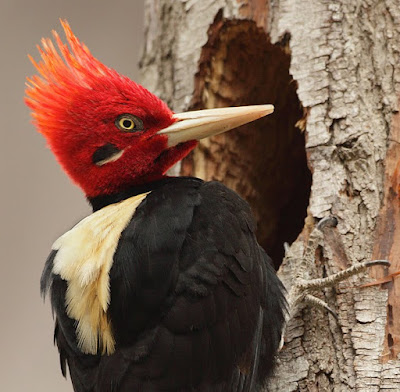
    This photo shows the bird's pale creamy mantle in excellent detail.  The male has a bright red head with black and white marks at the lower rear edge of its ear coverts.   Like some Campephilus relatives, the Cream-backed Woodpecker has a striking chisel-shaped, ivory-colored bill.

    You can also see here the long toe that the large Campephilus woodpeckers extend to their side to secure their stance against a tree.  It's a good brace against gravity!  You'd probably extend your arms out to either side like this if you found yourself braced against a cliff on a narrow ledge.

    The Cream-backed Woodpecker inhabits subtropical and dry tropical forests in south central South America in Argentina, Brazil, Paraguay and Uruguay.  Unlike several of its close relatives, this species occurs in savannas, and it can be observed visiting isolated trees in open areas.

    Cream-backed Woodpecker - 3 Photos

    Originally posted 3/22/11 - backdated to organize posts by topic.

      
    Silvia Vitale was kind enough to grant permission for me to post these excellent photos she took of a female Cream-backed Woodpecker.  She took them at La Cumbre, Cordoba Province, Argentina near the village.  As you see here, the female sports a striking, white moustachial stripe adjacent to her ivory bill.  The male bird's head is almost entirely red.  Cream-backed Woodpeckers inhabit xeric (dry) woodlands of the chaco habitat in southern-central parts of South America, occurring in savannas, pastures with copses, groves, woodland and transitional forests, up to 2,500m.*


    *Reference - Woodpeckers: A Guide to the Woodpeckers of the World by H. Winkler, DA Christie & D. Nurney.

    Cream-backed Woodpecker


    Many thanks to Gary Clark for granting permission to post his stunning photograph of a female Cream-backed Woodpecker here.  For more information about this photo, or two see other amazing photos by Gary Clark, visit his web albums at this link.

    Cream-backed Woodpecker


    Many thanks to Karisusi78 for sharing this video of a male Cream-backed Woodpecker from Paraguay.

    Cream-backed Woodpecker


    Many thanks to Karina Diarte on Flickr for sharing this striking photo of a male Cream-backed Woodpecker here. The photo is posted here with her permission.

    Cream-backed Woodpecker


    Many thanks to Karina Diarte on Flickr for sharing this beautiful photo of a female Cream-backed Woodpecker here. The photo is posted here with her permission.

    Carpintero Lomo Blanco

    Originally posted 10/19/10 - backdated to organize posts by topic.


    Here is an interesting video posted by infofon on YouTube that shows a female Carpintero Lomo Blanco, a Cream-backed Woodpecker, displaying an array of behaviors. Two birds are briefly in flight before one bird does a couple of double raps (typical of some members of the Campephilus genus) perhaps to signal another bird nearby. I'm not sure whether or not it is the same bird seen earlier, but toward the end of the video, you will see a female hitching herself up a tree trunk and then foraging.

    Press play, then change the setting at the lower right of the video box from  360p to 480p to watch it at higher resolution.

    I know a little Spanish, but not enough to translate the comments in this video. If you can translate them into English, please post a comment and then I'll revise this post with that info.  UPDATE - Thanks to Martjan for this translation of the video comments into English:

    "Well, we are going to try to continue observing. They told us it is very difficult to make a video take because they do not sit still. And they stay very few seconds in a tree and then fly to another tree. So we continue to walk, searching for other individuals around here".