Showing posts with label photos. Show all posts

Tuesday, September 22, 2015

Ivorybill Search: Across the Pascagoula: Otter Pond and Beyond

http://ibwos.blogspot.com/2015/09/across-pascagoula-otter-pond-and-beyond.html

http://www.ibwos.blogspot.com/2015/09/across-pascagoula-otter-pond-and-beyond.html

Brian Carlisle and Chris Carlisle maintain a fantastic site called "Kints" which documents their ongoing search for the Ivory-billed Woodpecker in southern Mississippi. Kints (or "kents") refers to the common note or call of the Ivorybill. Chris Carlisle recently did a great post describing their search of the Pascagoula Wildlife Management Area. It includes over six dozen photographs, two of which are posted here, with permission.

Reading through the post along with seeing so many beautiful photos of the forest that the Carlisles searched transported me back to the very special times that I found myself lucky enough to be searching for the Ivorybill, starting at dawn, in similarly beautiful forests in Florida, Louisiana and South Carolina.

Here's an excerpt from the Carlisle brothers' post that describes the forest:

Beautiful, mature second- and third-growth mixed bottomland hardwood and cypress/tupelo swamp forest, with a path running roughly northeast-southwest.  We decided to follow the path northeastward, and walked through some very nice hardwood forest habitat, with many different types of trees -- swamp chestnut oak, water oak, sycamore, holly, red maple, green ash, magnolia, what I believe to be pignut hickory, and shagbark hickory. 

Tuesday, November 12, 2013

Red-necked Woodpecker Species Account

pica-pau-de-barriga-vermelha femea by vhobusfoto

I recently authored a detailed species account on the Red-necked Woodpecker at Neotropical Birds Online (NBO).  It begins: 


The Red-necked Woodpecker is a large, spectacular Campephilus woodpecker of the rainforest.
 It is fairly common in Colombia and Venezuela and across the Guianas, and south through
 Amazonia to northern Bolivia.  

Each species account in NBO includes information on the identification, distribution, life history, conservation, and research references for a particular bird along with image and sound files for that species.  Visit NBO to read more about profiled Neotropical bird species and to see how you may contribute to authoring or enhancing additional species accounts!


The superb photo you see here is a female Red-necked Woodpecker near Matto Grasso, Brazil.  It is posted here with permission of talented wildlife photographer Valdir Hobus. 

Sunday, October 27, 2013

Carpintero Lomo Blanco

Carpintero Lomo Blanco by Javier Parigini
Carpintero Lomo Blanco, a photo by Javier Parigini on Flickr.
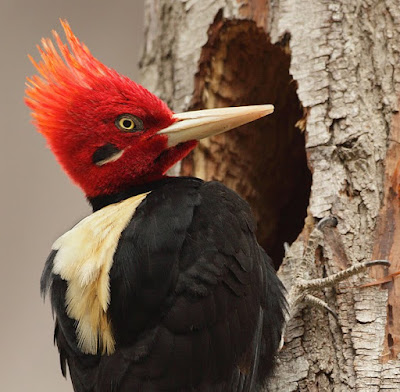
What an amazing portrait this is of a pair of Cream-backed Woodpeckers! The male is perched on the side of the tree, distinguished by his entirely red head with that black and white oval patch. The female is perched at the cavity, and she is distinguished by her black colored forehead and center of crest, and that rather dramatic looking white patch from the base of her bill tapering to a point below the rear of her ear coverts.

This fine photo was taken by Javier Parigini, and it is posted here with his permission.


Sunday, September 22, 2013

Powerful Woodpecker at Rio Blanco in Colombia

What a fine-looking male Powerful Woodpecker here in profile in full sunlight! Sexing this species is easy enough because the female's crest is black. This fine photo was taken by Francesco Veronesi at Rio Blanco, Colombia. It is posted here under Creative Commons license.

Tuesday, January 1, 2013

Ivory-billed Woodpeckers & Others in the Campephilus Genus

Click the image below to check out one of the largest collections of 
Campephilus woodpecker photos on the Internet!


You will find them in a Flickr group that I moderate called "Ivory-billed Woodpeckers & Others in the Campephilus Genus." Contributors share photos with this group on a weekly basis, so this marvelous collection of 4,985+ images is always growing!

Tuesday, February 16, 2010

WikiAves - A Enciclopédia das Aves do Brasil

WikiAves Encyclopedia of Brazilian Birds is an amazing resource of Campephilus descriptive information, photos and sounds.   WikiAves represents the four species of Campephilus woodpeckers, listed below, that can be found in Brazil.

The photographs that I have seen in WikiAves are among the most spectacular ones that I've seen anywhere.


In English and Portuguese, the four species of Campephilus in WikiAves are:


    Although the entry on the Cream-backed Woodpecker is rather slim (as of this posting) the others have a wealth of descriptive information.  And you'll find sounds and photos for all of them.  You can cut and paste the Portuguese text into your favorite web-based translator to understand the entries.

    Wednesday, February 10, 2010

    Cream-backed Woodpecker

     Originally posted 3/20/2010 - backdated to organize posts by topic.

    Some of the best woodpecker photos (Campephilus and others) that you will ever find are at a site called PicidPics, like this fantastic photo of a male Cream-backed Woodpecker. 

    PicidPics features photos of picids, including woodpeckers, piculets and wrynecks by Martjan Lammertink and Julio Pérez Cañestro.  The site also features photos of woodpecker researchers in the field and photos of secondary cavity users.

    Photo © Martjan Lammertink, posted here with permission.

    This photo shows the bird's pale creamy mantle in excellent detail.  The male has a bright red head with black and white marks at the lower rear edge of its ear coverts.   Like some Campephilus relatives, the Cream-backed Woodpecker has a striking chisel-shaped, ivory-colored bill.

    You can also see here the long toe that the large Campephilus woodpeckers extend to their side to secure their stance against a tree.  It's a good brace against gravity!  You'd probably extend your arms out to either side like this if you found yourself braced against a cliff on a narrow ledge.

    The Cream-backed Woodpecker inhabits subtropical and dry tropical forests in south central South America in Argentina, Brazil, Paraguay and Uruguay.  Unlike several of its close relatives, this species occurs in savannas, and it can be observed visiting isolated trees in open areas.

    Cream-backed Woodpecker - 3 Photos

    Originally posted 3/22/11 - backdated to organize posts by topic.

      
    Silvia Vitale was kind enough to grant permission for me to post these excellent photos she took of a female Cream-backed Woodpecker.  She took them at La Cumbre, Cordoba Province, Argentina near the village.  As you see here, the female sports a striking, white moustachial stripe adjacent to her ivory bill.  The male bird's head is almost entirely red.  Cream-backed Woodpeckers inhabit xeric (dry) woodlands of the chaco habitat in southern-central parts of South America, occurring in savannas, pastures with copses, groves, woodland and transitional forests, up to 2,500m.*


    *Reference - Woodpeckers: A Guide to the Woodpeckers of the World by H. Winkler, DA Christie & D. Nurney.

    Cream-backed Woodpecker


    Many thanks to Gary Clark for granting permission to post his stunning photograph of a female Cream-backed Woodpecker here.  For more information about this photo, or two see other amazing photos by Gary Clark, visit his web albums at this link.

    Cream-backed Woodpecker


    Many thanks to Karina Diarte on Flickr for sharing this striking photo of a male Cream-backed Woodpecker here. The photo is posted here with her permission.

    Cream-backed Woodpecker


    Many thanks to Karina Diarte on Flickr for sharing this beautiful photo of a female Cream-backed Woodpecker here. The photo is posted here with her permission.

    Pica-pau-de-barriga-preta (Campephilus leucopogon) - Fêmea

    Originally posted 10/6/12 - backdated to organize posts by topic.
    This is such a wonderful photograph of a female Cream-backed Woodpecker by talented photographer Cláudio Timm, posted here under Creative Commons license. The facial markings of this bird, extending the white coloration of the beak further back with similarly colored feathers, never ceases to amaze me! This is an attribute that Cream-backed Woodpeckers share with female members of two Campephilus sister species, the Red-necked and Robust Woodpeckers.

    Cream-backed Woodpecker


    Cream-backed Woodpecker, originally uploaded by Lathers.
    Many thanks to Lathers on Flickr for sharing this striking photo of a male Cream-backed Woodpecker here. The photo is posted here with his permission.

    Cream-backed Woodpecker - A Pair of Females

    Many thanks to arnemimiguel on Flickr for granting permission to post this photo of a pair of female Cream-backed Woodpeckers here.

    Cream-backed Woodpecker


    Cream-backed Woodpecker, originally uploaded by Charles Hesse.
    Many thanks to Charles Hesse for granting permission to post this photo of a male Cream-backed Woodpecker from Llanos de Moxos, Beni.

    Cream-backed Woodpecker

    Originally posted 4/10/2010 - backdated to organize posts by topic.


    Argen 007, originally uploaded by hanbyholmes.

    A male Cream-backed Woodpecker surveys its surroundings in Argentina.  Photo is © hanbyholmes and posted here with permission.

    Cream-backed Woodpecker

     Originally posted 4/10/2010 - backdated to organize posts by topic.


    5 Sep 06 - Cream-Backed Woodpecker - Cloudforests of Salta, Argentina, originally uploaded by hanbyholmes.

    A female Cream-backed Woodpecker with her black and red crest along with its namesake plumage visible too.  Photo © hanbyholmes and posted here with permission.  The photo is noted as taken in the Cloudforests of Salta, Argentina and I am guessing, in the lowland Chaco zone, though I'm not sure.  To read more about this area rich in biodiversity, follow this link.

    Tuesday, February 9, 2010

    Crimson-bellied Woodpecker - Tapichalaca, Ecuador

    Originally posted 8/10/11 - backdated to organize posts by topic.

    It's always great to find a good photograph of a Crimson-bellied Woodpecker because they are the least often photographed species of the Campephilus genus. They're also known by the name Splendid Woodpecker.  The white band down this bird's neck identifies it as a female. The male's neck is all red.  

    Thanks to Luke Seitz for granting permission to post his photo here! He writes:

    My experience with this individual was pretty brief, but it was the first time I'd seen the east slope subspecies of Crimosn-bellied, which is quite a bit brighter than the west slope subspecies and potentially a separate species...definitely a great bird either way!

    Crimson-bellied Woodpecker, Tapichalaca

    Originally posted 12/5/10 - backdated to organize posts by topic.

    Seeing this photo of a male Crimson-beliied Woodpecker is exciting because this large, colorful bird is so seldom photographed!  Female birds look similar to males, but they have a white band down the side of their neck.  It also goes by the name Splendid Woodpecker.  It is a forest-dwelling bird that can be found in eastern Panama, Columbia, Ecuador and Peru.

    This fine photo was taken in Tapichalaca, Ecuador by Pati Rouzer and it reaches us courtesy of Patty McGann.

    Crimson-bellied Woodpecker

    Crimson-bellied Woodpecker © Dubi Shapiro, posted with permission.

    This striking image of a Crimson-bellied Woodpecker was taken by Dubi Shapiro At Wildsumaco Lodge in December, 2008.   Wildsumaco is a new lodge built in the Andes foothills in eastern Ecuador.  This bird is a male.  In females, the white band across the cheeks continues down the side of the neck.  Rarely photographed, it is described as a very shy woodpecker that prefers to forage at low levels in dense forest.  In can be found along mountains of Central and northern South America from Panama through Colombia and western Ecuador to Peru.   


    Many thanks to Dubi for letting me share this photo with you.  Dubi has an extensive collection of remarkable wildlife photography.


    Reference
    - Woodpeckers: A Guide to the Woodpeckers of the World by H. Winkler, D. A. Christie & D. Nurney