Showing posts with label lammertink. Show all posts

Wednesday, February 10, 2010

Cream-backed Woodpecker

 Originally posted 3/20/2010 - backdated to organize posts by topic.

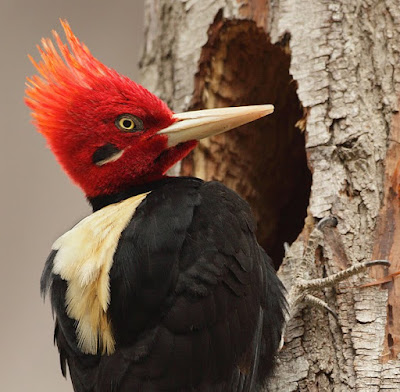
Some of the best woodpecker photos (Campephilus and others) that you will ever find are at a site called PicidPics, like this fantastic photo of a male Cream-backed Woodpecker. 

PicidPics features photos of picids, including woodpeckers, piculets and wrynecks by Martjan Lammertink and Julio Pérez Cañestro.  The site also features photos of woodpecker researchers in the field and photos of secondary cavity users.

Photo © Martjan Lammertink, posted here with permission.

This photo shows the bird's pale creamy mantle in excellent detail.  The male has a bright red head with black and white marks at the lower rear edge of its ear coverts.   Like some Campephilus relatives, the Cream-backed Woodpecker has a striking chisel-shaped, ivory-colored bill.

You can also see here the long toe that the large Campephilus woodpeckers extend to their side to secure their stance against a tree.  It's a good brace against gravity!  You'd probably extend your arms out to either side like this if you found yourself braced against a cliff on a narrow ledge.

The Cream-backed Woodpecker inhabits subtropical and dry tropical forests in south central South America in Argentina, Brazil, Paraguay and Uruguay.  Unlike several of its close relatives, this species occurs in savannas, and it can be observed visiting isolated trees in open areas.

Saturday, February 6, 2010

New Study Analyzes Only Known Footage of Vanished Imperial Woodpecker

Originally posted  10/26/11 - backdated to organize posts by topic.

There is big news today as the only film ever found of an Imperial Woodpecker is released in the form of 85 seconds of stunning color movie footage!  The film provides us with a unique look back through time at a species that is presumed to be extinct. 

 Imperial Woodpecker, female
Image by William L. Rhein, courtesy of Cornell Lab of Ornithology

At two-feet tall, the magnificent Imperial Woodpecker of Mexico was the largest woodpecker in the world.  It probably became extinct in the late 20th century.  To date, there has been no known photo or film documentation available of this species in life.  But that changes today with the publication of a new paper in the October, 2011 issue of The Auk, the journal of the American Ornithologists' Union.

The paper, by lead author Martjan Lammertink along with four Cornell Lab of Ornithology staff members and two Mexican biologists, is entitled Film Documentation of the Probably Extinct Imperial Woodpecker (Campephilus Imperialis).   It details the remarkable 16-mm color film of an Imperial Woodpecker shot in 1956 by William L. Rhein, a dentist and amateur ornithologist.  Rhein shot the film with a hand-held camera from the back of a mule while camping in a remote location in the Sierra Madre Occidental in Durango state, Mexico.

Here is a link where you can view the 85-second color film, download the Auk article, hear Rhein narrate scenes from his 1956 expedition, read about the March 2010 follow up expedition to the film site, and see the painted Imperial Woodpecker cover art that serves as the cover of the current edition of The Auk:


Although Rhein has been widely attributed with the last sighting record of an Imperial Woodpecker, the existence of his film was not known until recently.  In the mid-1990s, biologist M. Lammertink discovered a mention of the film at Cornell in letters that Rhein and a colleague sent to ivorybill researcher James Tanner in 1962.  He tracked Rhein down and they viewed the film together in 1997.  In 2005 Rhein's nephew, R. Thorpe, donated the film to the Macaulay Library at the Cornell Lab of Ornithology.        

 Imperial Woodpecker, female
Image by William L. Rhein, courtesy of Cornell Lab of Ornithology 

Viewing the amazing film footage, you will see a female Imperial Woodpecker hitching up and foraging on the trunks of large Durango pines in its old-growth forest environment before launching into flight.  A March 2010 expedition to the film site gained insights on the bird's probable extinction, but turned up no evidence that Imperial Woodpeckers are still alive.  Unfortunately, the bird and its old-growth forest are gone now, making the film footage an especially precious find.

Thursday, February 4, 2010

Forest Birds of the World - Magellanic Woodpecker

Originally posted 12/28/11 - backdated to organize posts by topic.
 
Congratulations to researcher Martjan Lammertink who won first prize in November 2011 for the category Forest Birds of the World with this photo of a juvenile male Magellanic Woodpecker that he took in Nahuel Huapi National Park, Argentina. The photo contest was organized by SEO/BirdLife, the branch of BirdLife International in Spain, to commemorate the International Year of Forests 2011.

The fact that the winning photos were selected from a total of 1,050 images submitted by 305 professionals from 13 countries is a testament to how attractive and charismatic Magellanic Woodpeckers are as forest ambassadors.

Find more details and the two other first prize winning photos here:


Monday, February 1, 2010

Talking with a Pale-billed Woodpecker

Originally posted 5/15/10 - backdated to organize posts by topic.

Back in November of last year, the Cornell Lab of Ornithology (CLO) released this fascinating 10+ minute video entitled Talking with a Pale-billed Woodpecker. One of several excellent bird videos by CLO, it is available in 1080p HD (you may need to adjust your settings to see it in HD) and takes you on a hike through a Costa Rican rain forest in search of the Pale-billed Woodpecker. Researchers Martjan Lammertink and Chris Saker utilized a wooden box especially designed to simulate the double-knock sound that Pale-billed Woodpeckers and other members of the Campephilus genus use as a communication signal.

Watch how the bird rewards their efforts to draw it closer to them using the double-knocker by flying into the area and then doing its own series of double-knocks in response to what it has heard. It's also quite nice to be able to watch a male Pale-billed Woodpecker emerge from its roost in the beautiful forest in Costa Rica at dawn (all in HD video, so great viewed at full screen size), without having to get up that early!
 

Friday, January 29, 2010

Robust Woodpecker Feeding Its Young

Originally posted 12/28/11 - backdated to organize posts by topic. 


This video of a female Robust Woodpecker, Pica-pau-rei, feeding its nestling is remarkable for its quality. You can adjust settings at your end to watch the video in 720p HD. It's interesting to see how it takes a while for the adult bird to transfer the beetle grub to the young bird. This is one of many excellent videos and photos that can be found at Fotografias da Natureza, a site by Jorge Kutsmi where he shares beautiful imagery that he has captured in the Atlantic Forest in Brazil. 

Below is an introduction from Jorge Kutsmi's site (translated into English using Google) along with a link to his site.


Birds of the Atlantic Forest
Most people do not have the opportunity to be in touch with nature and see that there are still gems to survive despite the ravages and neglect by which, directly or indirectly we are all responsible. This reality, the idea of ​​recording a short drive by the Atlantic Forest, to observe their birds, captured by the lens of a camera. Admire them here while they live there in the forest free, perpetual colors, sounds and movements: the nobility of photography!

And here is the intriguing story of this video:

Martjan Lammertink said...
A remarkable thing about this video is that the cavity seems extremely shallow and that the chick seems to be sitting horizontally on the bottom while it is being fed. Typically, Campephilus nest holes (and those of most other woodpeckers) are quite deep. When the chicks are near fledging, they receive food in the nest entrance but in a different posture than what is seen in the video. I e-mailed the film maker Jorge Kutsmi to ask if there was a special circumstance that made the chick end up in this odd, apparent emergency situation of a cavity, and indeed Jorge wrote back to me with the following:

“The explanation I got was that the nest was originally in the same tree (an embaúba tree in an advanced stage of decay). A rain storm with strong gusts of wind broke the tree exactly where the original nest cavity was. The person who took care of the land found the broken tree and two young woodpeckers, one dead and another alive and all wet. Because the parents were around he put the chick in another cavity in the part of the same tree that was still standing and they started to feed him. It is even possible the hole in the video was made by the person who rescued the chick, I never met him and did not hear more details of the event”.
 

Robust Woodpecker with a Lineated Woodpecker

Originally posted 4/4/13 - backdated to organize posts by topic.

Here is an interesting photo out of the Atlantic Forest in Argentina by field researcher Dr. Martjan Lammertink. It features a male Robust Woodpecker, a member of the Campephilus genus, at the cavity entrance, along with a male Lineated Woodpecker, a member of the Dryocopus genus, outside on the tree trunk. The Lineated Woodpecker is often confused with another member of the Campephilus genus, the Crimson-crested Woodpecker, both of which are very wide-ranging species. I could sure imagine the Robust Woodpecker saying something like "Hey, move along buddy!" to this fellow woodpecker! To see more photos by Martjan Lammertink, visit:


Incidentally, this photo reminds me of the time I observed four species of woodpeckers all visiting the pear tree in my family's backyard at the same time one fine autumn day in Queens, NYC. Those four species, representing four different genera, were Downy Woodpecker, Northern Flicker, Red-bellied Woodpecker, and Yellow-bellied Sapsucker. Sure wish I had a photo of all of them as fine as this one!