Tuesday, February 16, 2010

Listen at Xeno-Canto

Xeno-canto is a community database of shared bird sounds from around the world.  It's an ever-growing collection of bird sounds.  At xeno-canto, you can listen to dozens of Campephilus woodpecker vocalizations, drumming and knocks from 9 out of the 12 species.  Missing are any sounds of the Ivory-billed Woodpecker, the Cuban Ivory-billed Woodpecker and the Imperial Woodpecker.  That still leaves a multitude of recordings of the rest of the Campephilus family for your enjoyment and study


Xeno-canto lets visitors to its site participate by discussing and identifying unknown sounds.  And, if you record bird sounds, you should know that xeno-canto also lets people upload and share their own recordings on the site.

Also, don't miss the highly informative Species Overview  pages on Xeno-Canto.  Available from the left frame menu, these pages offer a summary of number of species sound recordings, photos, range maps and sonogram images.   See this page, for example:

WikiAves - A Enciclopédia das Aves do Brasil

WikiAves Encyclopedia of Brazilian Birds is an amazing resource of Campephilus descriptive information, photos and sounds.   WikiAves represents the four species of Campephilus woodpeckers, listed below, that can be found in Brazil.

The photographs that I have seen in WikiAves are among the most spectacular ones that I've seen anywhere.


In English and Portuguese, the four species of Campephilus in WikiAves are:


    Although the entry on the Cream-backed Woodpecker is rather slim (as of this posting) the others have a wealth of descriptive information.  And you'll find sounds and photos for all of them.  You can cut and paste the Portuguese text into your favorite web-based translator to understand the entries.

    SIB - Parques Nacionales - Sistema de Información sobre Biodiversidad

    There are 4 species of Campephilus that are native to Argentina which contain interesting and detailed profiles (en Español) along with dramatic illustrations of each species, except the Robust Woodpecker, at the SIB - Parques Nacionales - Sistema de Información sobre Biodiversidad site.  Be a bit patient to allow this site to load.


    In English and with their Spanish names, the four species of Campephilus at the SIB site are:

              Carpintero grande


              Carpintero patagónico


    Monday, February 15, 2010

    SORA Searchable Ornithological Research Archive

    Originally posted 4/10/10 - backdated to organize posts by topic.


    This posts highlights the extraordinary SORA project, the source of an incredible array of ornithological journal articles.  The SORA project is described as follows at the site:

    The SORA project is an open access electronic journal archive and is the product of a collaboration between the American Ornithologists Union, the Cooper Ornithological Society, the Association of Field Ornithologists, the Wilson Ornithological Society and the University of New Mexico libraries and IT department. 


    Of course, there are many interesting articles on Campephilus woodpeckers within SORA.  For example, searching for the word "guayaquil" by keyword quickly retrieves this full-text article from within SORA:


    WILLIAMS First Description of the Nest, Eggs and Nestling of the Guayaquil Woodpecker (Campephilus [Phloeoceastes] Gayaquilensis) (Wilson Bulletin: Vol. 92, No. 4, October-December, 1980)


    Here is an excerpt from that article:

    The nest cavity was in the main trunk about 6 m above the ground. Its irregularly shaped entrance was large enough (about 75 x 100 mm) to admit my hand, and it was about 30 cm deep. I could not reach the cavity’s bottom or its contents, but using a mirror, I saw 1 egg and 1 newly-hatched young. The shell of the hatched egg was still in the nest. The eggs were white and immaculate-typical large woodpecker eggs. The nestling was making weak chirping sounds. Its eyes were closed, and it appeared naked; however, in the dim light of the cavity, sparse down probably would not have been obvious. It had a conspicuous eggtooth. I visited this nest again at 13:50. After approaching within 6-8 m of the female at the cavity entrance, I made several color transparencies (Frontispiece). I never saw more than 1 adult at this site.

    I am amazed at how little still is known of the breeding and behavior of the Campephilus woodpeckers.

    Wednesday, February 10, 2010

    Cream-backed Woodpecker

     Originally posted 3/20/2010 - backdated to organize posts by topic.

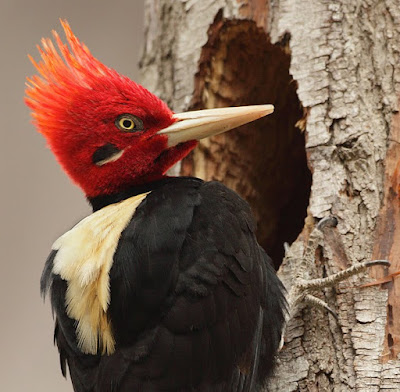
    Some of the best woodpecker photos (Campephilus and others) that you will ever find are at a site called PicidPics, like this fantastic photo of a male Cream-backed Woodpecker. 

    PicidPics features photos of picids, including woodpeckers, piculets and wrynecks by Martjan Lammertink and Julio Pérez Cañestro.  The site also features photos of woodpecker researchers in the field and photos of secondary cavity users.

    Photo © Martjan Lammertink, posted here with permission.

    This photo shows the bird's pale creamy mantle in excellent detail.  The male has a bright red head with black and white marks at the lower rear edge of its ear coverts.   Like some Campephilus relatives, the Cream-backed Woodpecker has a striking chisel-shaped, ivory-colored bill.

    You can also see here the long toe that the large Campephilus woodpeckers extend to their side to secure their stance against a tree.  It's a good brace against gravity!  You'd probably extend your arms out to either side like this if you found yourself braced against a cliff on a narrow ledge.

    The Cream-backed Woodpecker inhabits subtropical and dry tropical forests in south central South America in Argentina, Brazil, Paraguay and Uruguay.  Unlike several of its close relatives, this species occurs in savannas, and it can be observed visiting isolated trees in open areas.

    Cream-backed Woodpecker - 3 Photos

    Originally posted 3/22/11 - backdated to organize posts by topic.

      
    Silvia Vitale was kind enough to grant permission for me to post these excellent photos she took of a female Cream-backed Woodpecker.  She took them at La Cumbre, Cordoba Province, Argentina near the village.  As you see here, the female sports a striking, white moustachial stripe adjacent to her ivory bill.  The male bird's head is almost entirely red.  Cream-backed Woodpeckers inhabit xeric (dry) woodlands of the chaco habitat in southern-central parts of South America, occurring in savannas, pastures with copses, groves, woodland and transitional forests, up to 2,500m.*


    *Reference - Woodpeckers: A Guide to the Woodpeckers of the World by H. Winkler, DA Christie & D. Nurney.

    Cream-backed Woodpecker


    Many thanks to Gary Clark for granting permission to post his stunning photograph of a female Cream-backed Woodpecker here.  For more information about this photo, or two see other amazing photos by Gary Clark, visit his web albums at this link.

    Cream-backed Woodpecker


    Many thanks to Karisusi78 for sharing this video of a male Cream-backed Woodpecker from Paraguay.

    Cream-backed Woodpecker


    Many thanks to Karina Diarte on Flickr for sharing this striking photo of a male Cream-backed Woodpecker here. The photo is posted here with her permission.

    Cream-backed Woodpecker


    Many thanks to Karina Diarte on Flickr for sharing this beautiful photo of a female Cream-backed Woodpecker here. The photo is posted here with her permission.

    Carpintero Lomo Blanco

    Originally posted 10/19/10 - backdated to organize posts by topic.


    Here is an interesting video posted by infofon on YouTube that shows a female Carpintero Lomo Blanco, a Cream-backed Woodpecker, displaying an array of behaviors. Two birds are briefly in flight before one bird does a couple of double raps (typical of some members of the Campephilus genus) perhaps to signal another bird nearby. I'm not sure whether or not it is the same bird seen earlier, but toward the end of the video, you will see a female hitching herself up a tree trunk and then foraging.

    Press play, then change the setting at the lower right of the video box from  360p to 480p to watch it at higher resolution.

    I know a little Spanish, but not enough to translate the comments in this video. If you can translate them into English, please post a comment and then I'll revise this post with that info.  UPDATE - Thanks to Martjan for this translation of the video comments into English:

    "Well, we are going to try to continue observing. They told us it is very difficult to make a video take because they do not sit still. And they stay very few seconds in a tree and then fly to another tree. So we continue to walk, searching for other individuals around here".

    Cream-backed Woodpeckers: A Closer Look

    Originally posted 7/4/10 - backdated to organize posts by topic.


    It's hard to convey the brilliance of the nearly 150-year old, hand-colored lithographs in Alfred Malherbe's Monographie des Picidées that one sees upon viewing the genuine article.  A closer look at the Cream-backed Woodpeckers depicted in Plate III (female, above and male, below) helps to reveal more of their fine detail.  My apologies if the occasional large-sized photos I post are less than ideal for your particular monitor.


    The flight feather on the right belongs to the Robust Woodpecker.  See the full Plate III illustration for a comparison of Cream-backed and Robust Woodpecker flight feathers.

    This illustration is within the public domain appears here courtesy of the Rare Book & Manuscript Library, Columbia University in the City of New York.

    Mégapic de Boié, the Cream-backed Woodpecker

    Originally posted 7/3/10 - backdated to organize posts by topic.

    Here's Plate III from Alfred Malherbe's Monographie des Picidées depicting the striking female Cream-backed Woodpecker on the left, the male bird on the right, and a pair of Robust Woodpeckers in the background.

    Clicking on any of these illustrations will take you into my album of Malherbe's illustrations where you can download large-sized illustration files. The image above is within the public domain and it appears here courtesy of the Rare Book & Manuscript Library, Columbia University in the City of New York.

    Cream-backed Woodpeckers: Two Videos

     Originally posted 8/21/2010 - backdated to organize posts by topic.

    Enjoy two videos recently posted by baco1970 that show the striking Cream-backed Woodpecker in Brazil.

    The first video shows a male bird that has a red crest and red head with a small oval of black and white at the lower rear edge of its ear coverts.  The second video shows one male with two female birds whose crests are a bit longer than the male's, with black from the forehead up through the central area of the crest.  Females birds also display dramatic looking moustachial stripes.

    To view many more amazing bird videos, visit baco1970's YouTube channel 
    or the Pantanal Bird Club site!


    This video and the next one are best viewed in their enhanced versions.  Be sure to click 360p in the lower right corner of the frame and select 480p as soon as they start to play.

    Pica-pau-de-barriga-preta (Campephilus leucopogon) - Fêmea

    Originally posted 10/6/12 - backdated to organize posts by topic.
    This is such a wonderful photograph of a female Cream-backed Woodpecker by talented photographer Cláudio Timm, posted here under Creative Commons license. The facial markings of this bird, extending the white coloration of the beak further back with similarly colored feathers, never ceases to amaze me! This is an attribute that Cream-backed Woodpeckers share with female members of two Campephilus sister species, the Red-necked and Robust Woodpeckers.

    Cream-backed Woodpecker Family

    Originally posted 9/13/2010 - backdated to organize posts by topic.


    Here's a video of a Cream-backed Woodpecker family group that has a pleasant soundtrack and also includes interesting vocalizations by the birds.   Near the end, just before the one minute mark, note the two double-knocks that the male bird does which compel a female bird to draw close, from the bottom then toward him by hitching herself up the tree trunk!

    Thanks to Michael Blendinger for sharing this clip with us.

    Visit his Discovering Bolivia site here.

    Cream-backed Woodpecker


    Cream-backed Woodpecker, originally uploaded by Lathers.
    Many thanks to Lathers on Flickr for sharing this striking photo of a male Cream-backed Woodpecker here. The photo is posted here with his permission.

    Cream-backed Woodpecker - A Pair of Females

    Many thanks to arnemimiguel on Flickr for granting permission to post this photo of a pair of female Cream-backed Woodpeckers here.

    Cream-backed Woodpecker


    Cream-backed Woodpecker, originally uploaded by Charles Hesse.
    Many thanks to Charles Hesse for granting permission to post this photo of a male Cream-backed Woodpecker from Llanos de Moxos, Beni.

    Cream-backed Woodpecker

    Originally posted 4/10/2010 - backdated to organize posts by topic.


    Argen 007, originally uploaded by hanbyholmes.

    A male Cream-backed Woodpecker surveys its surroundings in Argentina.  Photo is © hanbyholmes and posted here with permission.

    Cream-backed Woodpecker

     Originally posted 4/10/2010 - backdated to organize posts by topic.


    5 Sep 06 - Cream-Backed Woodpecker - Cloudforests of Salta, Argentina, originally uploaded by hanbyholmes.

    A female Cream-backed Woodpecker with her black and red crest along with its namesake plumage visible too.  Photo © hanbyholmes and posted here with permission.  The photo is noted as taken in the Cloudforests of Salta, Argentina and I am guessing, in the lowland Chaco zone, though I'm not sure.  To read more about this area rich in biodiversity, follow this link.

    Tuesday, February 9, 2010

    Crimson-bellied Woodpecker - Tapichalaca, Ecuador

    Originally posted 8/10/11 - backdated to organize posts by topic.

    It's always great to find a good photograph of a Crimson-bellied Woodpecker because they are the least often photographed species of the Campephilus genus. They're also known by the name Splendid Woodpecker.  The white band down this bird's neck identifies it as a female. The male's neck is all red.  

    Thanks to Luke Seitz for granting permission to post his photo here! He writes:

    My experience with this individual was pretty brief, but it was the first time I'd seen the east slope subspecies of Crimosn-bellied, which is quite a bit brighter than the west slope subspecies and potentially a separate species...definitely a great bird either way!

    Crimson-bellied Woodpecker, Tapichalaca

    Originally posted 12/5/10 - backdated to organize posts by topic.

    Seeing this photo of a male Crimson-beliied Woodpecker is exciting because this large, colorful bird is so seldom photographed!  Female birds look similar to males, but they have a white band down the side of their neck.  It also goes by the name Splendid Woodpecker.  It is a forest-dwelling bird that can be found in eastern Panama, Columbia, Ecuador and Peru.

    This fine photo was taken in Tapichalaca, Ecuador by Pati Rouzer and it reaches us courtesy of Patty McGann.

    Crimson-bellied Woodpecker

    Crimson-bellied Woodpecker © Dubi Shapiro, posted with permission.

    This striking image of a Crimson-bellied Woodpecker was taken by Dubi Shapiro At Wildsumaco Lodge in December, 2008.   Wildsumaco is a new lodge built in the Andes foothills in eastern Ecuador.  This bird is a male.  In females, the white band across the cheeks continues down the side of the neck.  Rarely photographed, it is described as a very shy woodpecker that prefers to forage at low levels in dense forest.  In can be found along mountains of Central and northern South America from Panama through Colombia and western Ecuador to Peru.   


    Many thanks to Dubi for letting me share this photo with you.  Dubi has an extensive collection of remarkable wildlife photography.


    Reference
    - Woodpeckers: A Guide to the Woodpeckers of the World by H. Winkler, D. A. Christie & D. Nurney

    Crimson-bellied Woodpecker Illustration

    Originally posted 12/14/10 - backdated to organize posts by topic.

    Here is a hand-colored lithograph depicting the very colorful Crimson-bellied Woodpecker in Plate IX by Delahaye from Alfred Malherbe's Monographie des picidées (1859-1862).  Figure 1 and 3 represent male birds and figure 2, the bird with the white band on its neck, is a female.  Over the past several months, I have been posting the plates from this monumental work which illustrate the eleven species of Campephilus woodpeckers, a task that is now complete with the posting of this ninth plate. 

    The monograph contains large illustrations of both sexes of the 140 woodpecker species new to science at the time and reduced illustrations of the known species.  The birds depicted here in the left background are Orange-backed Woodpeckers.  Not within the Campephilus genus, the large Orange-backed Woodpecker (Reinwardtipicus validus) of South-east Asia is the sole member of its genus.  Along with the members of the Flameback or Chrysocolaptes genus, perhaps (based upon its appearance) it is one of the species that is more closely related to the Campephilus tribe than the other woodpeckers.   


    I was able to photograph all 123 hand-colored lithographic plates from the Monographie des picidées.  Each plate contains beautiful and interesting illustrations.  I hope to make all of the plates available online in the future, though I am not sure when I will get to it.  In the meantime, please feel free to contact me if you're ever in need of the corresponding plate for a particular woodpecker species.

    This image within the public domain appears here courtesy of the Rare Book & Manuscript Library, Columbia University in the City of New York.

    Mégapic à Cou Rouge

    Originally posted 6/6/10 - backdated to organize posts by topic.

    Marvelous hand-colored lithographs of each Campephilus woodpecker species appear in Alfred Malherbe's extraordinary Monographie des Picidées, a work that dates back to the early 1860s.  These along with many other illustrations depict the then known species of woodpeckers in a total of 123 fine, hand-colored lithographic plates by C.Delahaye, A. Mesnel and P.Oudart under the direction of Malherbe.  This one is a detail from Plate IX which is entitled Mégapic à Cou Rouge, the Crimson-bellied Woodpecker. 

    What is an aficionado to do but spend an afternoon off visiting the rare book room at a local university to examine this epic tome and secure high quality images, as freely permitted at said institution, and then share them with you here at Campephilus Woodpeckers?  And so, I present you with just a bit of something to truly look forward to, if you enjoy this sort of fantastic imagery.

    You can read more about Alfred Malherbe's magnificent work at this post. 

    And, see this work's depiction of the largest woodpecker in the world right here.

    The additional  Campephilus illustrations from Malherbe's work will be coming here soon!

    This image within the public domain appears here courtesy of the Rare Book & Manuscript Library, Columbia University in the City of New York.

    Crimson-bellied Woodpecker


    Image in the public domain, courtesy of Cornell University Library
    Digital Collections, Fuertes Illustration Collection at

                                  Context: Annotation: "Campephilus Peruvian Andes"
                                  Date: 1911c.
                                  Location: Rare and Manuscript Collections
                                  Medium: Pencil;Watercolor
                                  ID Number: 2662-800-0670 
                                  Size: 9" x 5.75" 
                                  Support: Paper
                                 Type: Studies;Watercolors
                                 Title: Crimson-bellied Woodpecker